
By Dominique Jean, MoveUP Environment Committee. Dominique is a beekeeper and a member of the BC Honey Producers Association.
World Bee Day is May 20, 2026. It aims to raise the importance of bees’ contributions to the environment. One-third of the world’s food production depends on bees as pollination causes crops to reproduce.
There are 3 kinds of bees in a honeybee colony:
The Worker Bee
Worker bees are female bees that do not reproduce. They develop from fertilized eggs and live for about 4 weeks. These are the bees that can sting.
The Queen
The queen is the only bee responsible for reproduction and her only task is to lay eggs. Queens can lay as many as 15,000 eggs per day from around February to mid-October.
The Drone
Drones are male bees that develop from unfertilized eggs. The purpose of a bee colony is to rear drones and have one or more of them mate with a virgin queen from another colony. The drone does not perform any other duties and cannot sting.
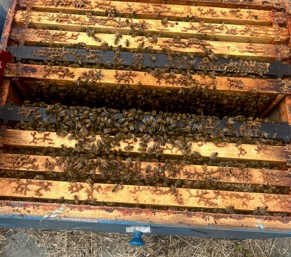
To start a beehive, people usually go to a beekeeping shop and buy a nucleus. A nucleus is a small group of bees including worker bees, drones, one mated queen, and growing bees in all stages starting from larvae. The bees will reproduce and grow into a full hive, and you can also split them into more hives when there are a lot of bees in your first hive. Hives with no queen are able to produce their own. The frames in beehives are made of plastic or wood with plastic comb pre-coated in wax. The bees will eventually coat these in honey which is harvested in the fall.
Hives can be inspected around every 10-14 days ideally when the weather is warmer with no rain (beekeeping season in British Columbia is from around April to October).
The beekeeper needs to remove each frame individually to see if the bees are producing honey and growing in population. Ideally the beekeeper should be able to find the queen in each hive as well. Before removing the frames, it is important to use a smoker to smoke the entrance of the hive. Burlap, leaves, or pine needles can be lit to create the smoke. This helps calm the bees down.
Bee hives also need to be periodically checked for diseases at least twice per year. The two main threats to bee survival are European Foulbrood and Varroa Mites. Sometimes the beekeeper can tell if there is an infestation by the appearance of the bees. You can also do a test where you coat a cup of bees with icing sugar and see if there are any mites after putting the icing sugar through a strainer and adding water.
If diseases are not managed, the bees will eventually die. If there is a disease in the hive there are treatments that are available.
To observe World Bee Day, you can:
- Plant nectar-producing flowers in your garden or on your balcony such as clover, lavender, and sunflowers. More information is available at Selecting bee forage plants – Province of British Columbia
- Support or donate to an environment or bee charity
- Buy honey and bee products from your local beekeeper
- Put a shallow bowl of water for bees to drink containing pebbles, marbles, or other small objects (to prevent the bees from drowning)
- Consider taking a beekeeping course and putting a hive in your yard
- Mason bees are another option as they pollinate but do not produce honey or live in hives (they are also easier to maintain compared to honeybees)