
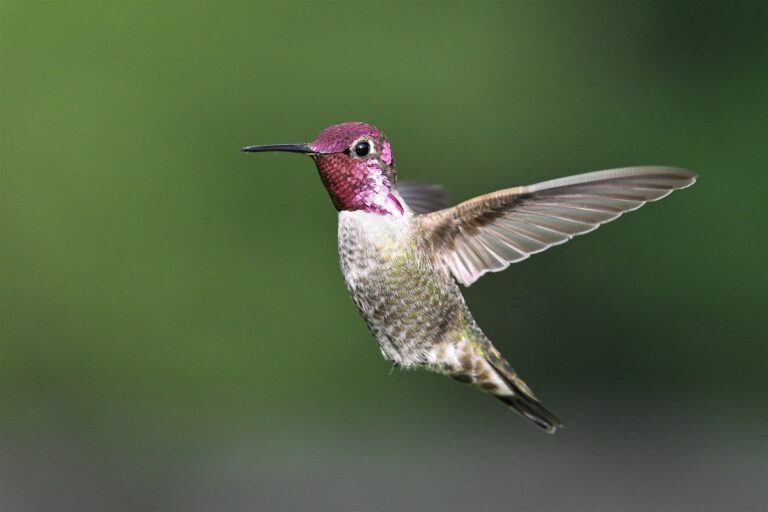
By Jennifer Morgan, MoveUP Environment Committee member
Fun Facts: Hummingbirds are the only birds that can fly backwards.
Anna’s hummingbird is a year‑round resident along the Pacific Coast, including British Columbia. They face enormous challenges in cold months: natural food sources such as insects and nectar‑bearing flowers become scarce, and freezing temperatures threaten their survival.
They are important pollination powerhouses but transferring pollen while feeding on nectar. They also help with pest control as they also eat small gnats, aphids, mites, and spiders. Because they are sensitive to environmental changes, hummingbirds also act as biodiversity indicators.
Humans can play a vital role in supporting them. The most important step is maintaining clean, reliable nectar feeders. A simple sugar‑water solution (one part sugar to 3-4 parts water, boiled and cooled) provides essential calories.
Feeders must be cleaned weekly to prevent harmful fungal growth, and nectar should be replaced every few days. Just as crucial, feeders must never freeze—wrapping them with outdoor lights, placing them in sheltered areas, or bringing them indoors overnight can keep nectar accessible.
If you use feeders, please consider this is a long-term commitment (especially for the winter season) as come to rely on your feeders as a winter food source.
Sources
Keeping hummingbirds safe in winter – BC SPCA
Hummingbirds may need extra help surviving recent frigid temperatures | CBC News
Feeding Hummingbirds In Winter: Tips & Tricks – Wild Bird Trust of British Columbia
What Are Hummingbirds Good For: 6 Benefits! – Birds Idea
What do hummingbirds do for humans? – The Institute for Environmental Research and Education