
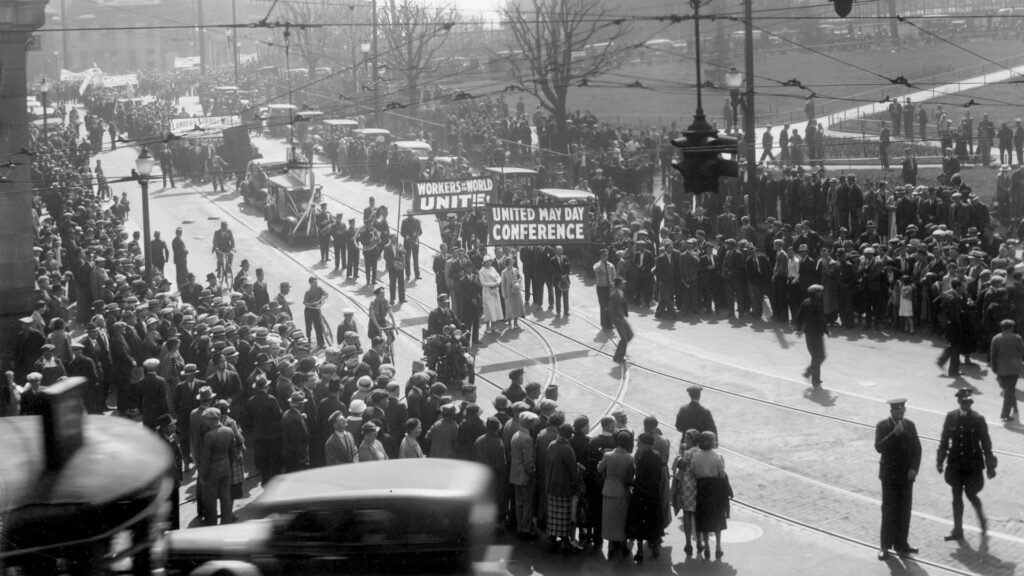
Photo: United May Day Conference Parade on Cambie Street in Vancouver passing Victory Square, May 2, 1936 (credit: Vancouver Police Department, Office of the Chief of Police, Vancouver Archives)
Every year in Canada, we observe Labour Day on the first Monday of September. Labour Day is a statutory holiday. Although the purpose of the day is to celebrate the achievements of working people, it has become more known as a day for family-friendly activities and less so as a rally cry for workers’ rights.
Around the world, it is International Workers’ Day that remains the symbol of the workers’ rights movement.
International Workers’ Day, also known as May Day, falls annually on May 1. It celebrates and honours workers around the world and everything the labour movement has fought for.
International Workers’ Day origins
International Workers’ Day’s origins date back to the late 19th century and has its roots as a movement as part of a campaign to establish the 8-hour workday.
On May 1, 1886, workers in cities across the United States began a general strike to fight for that cause. It would culminate in a bloody, violent clash between protesters and police on May 4 in Chicago’s Haymarket Square, now referred to as the Haymarket Affair or the Haymarket Riot.
Since then, May 1 has become a symbol of the fight for workers’ rights and the origins of International Workers’ Day.
Labour Day origins
Labour Day in Canada can trace its roots back to the 1872 printer’s strike, spearheaded by the Toronto Typographical Union. Their campaign was the “Nine Hour Movement,” looking to shorten the workday down from the 12+ hours that was common at the time.
This strike led to the passing of the 1872 Trades Union Act that would legalize union membership. The strike also inspired an annual celebration, one of which was witnessed by American labour leader Peter J. McGuire in 1882, who took the idea back to New York and organized the first American “Labor Day” on September 5, 1882.
The New York City Labor Day Parade remains an annual tradition to this day.
Back in Canada, it would not be until 1894 when a law was passed making Labour Day official, six years after the Haymarket Affair.
International Workers’ Day in Canada
The first International Workers’ Day celebration in Canada was held in 1906 in Montreal. Under the slogan “Workers of the world, unite” it was heavily comprised of social-democratic groups, including the social workers’ party and the industrial workers union.
The socialist influence led some in the labour movement to shy away from associating with May Day, choosing instead to recognize Labour Day. But May Day continued to persist and would increase in scope in the 1921 with the founding of the Communist Party of Canada CPC).
When the CPC was declared illegal in 1931, May Day celebrations became suppressed by the RCMP and other police forces. The ban on the CPC ended in 1936 and the party returned to take part in May Day festivities.
May Day experienced a decline due to the political climate after the end of World War II and with the Cold War but made a strong comeback in the 1970s particularly in Quebec with the formation of the common front of trade unions in 1972.
Today, even though it is not officially recognized in Canada, there are still gatherings and parades that are held.
Labour Day in Canada
Labour Day has been observed in Canada since Prime Minister John Thompson made it official in 1894. It had previously been declared a civic holiday in Montreal in 1889.
It is believed that one of the main political motivations for declaring Labour Day as a holiday was to draw attention away from the more militant International Workers’ Day, which was becoming more popular with union members. The politicians of the day feared that union members could become a voting block. It was also a way to disassociate workers from the social elements of International Workers’ Day.
Labour Day parades are typically held in many parts of the country, while labour councils also organized gatherings to commemorate the day.
International Workers’ Day vs. Labour Day
While both days serve to recognize, celebrate, and honour the achievements of working people and the labour movement, without question International Workers’ Day is much lesser recognized in Canada, and North America, compared to Labour Day.
International Workers’ Day continues to be celebrated in many places around the world on May 1, many of whom refer to it as their own “Labour Day.”
The best way to describe the difference between the two may be to say International Workers’ Day focuses on education, while Labour Day focuses on entertainment.
Many labour councils today are working to revitalize International Workers’ Day to help union members and all workers today remember its historic significance and urging workers to continue fighting for change.
At the same time, they are also looking to bring the spirit of International Workers’ Day to Labour Day celebrations to balance the fun and games of the latter with strong emphasis on workers’ rights of the former.